Playbooks
AI to human handoff: when your voice agent should call in a person
AI to human handoff, done right: when your voice agent should pass a live call to a person, which transfer to use and what callers hear if nobody is free.

An AI to human handoff should never drop the call. With AI transfer in MagickVoice, your AI voice agent tells the caller it’s connecting them, rings your whole team at once, and whoever picks up first carries on the conversation. Here’s a one-minute demo:
So when should the AI hand over? The moment the caller asks for a person. It should also hand over when the call needs human judgement: a complaint, a dispute, an upset caller or a change to money or cover. A good handoff doesn’t end the call. It tells the caller what is happening, reaches someone fast and lands at the desk that can solve the problem.
This playbook is for support and operations heads. It covers when to transfer, which kind of transfer to use, what callers hear if nobody is free, how to stop people repeating themselves, and what to measure.
Why does the handoff decide whether customers trust your AI?
Because callers judge an AI agent by how easy it is to get past it. Indian consumers are open to AI support, but only with a clear exit.
97% of Indian consumers value moving easily from AI to a human. 46% would rather start with a human, even if it takes longer (Twilio and YouGov, 2025). In the same survey, one in three named “no clear way to escalate to a human” as a top complaint.
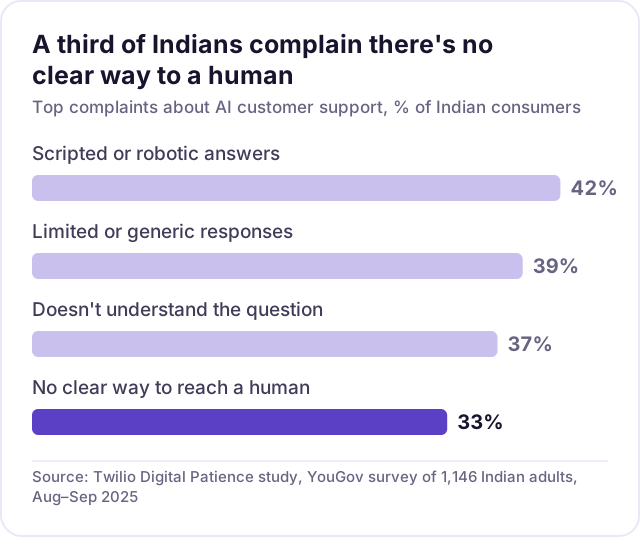
Indians are also warming to AI. 67% say they are more likely to choose an AI chatbot over a human than they were a year ago (Twilio, 2026). So the real problem isn’t AI. It’s AI that won’t let go.
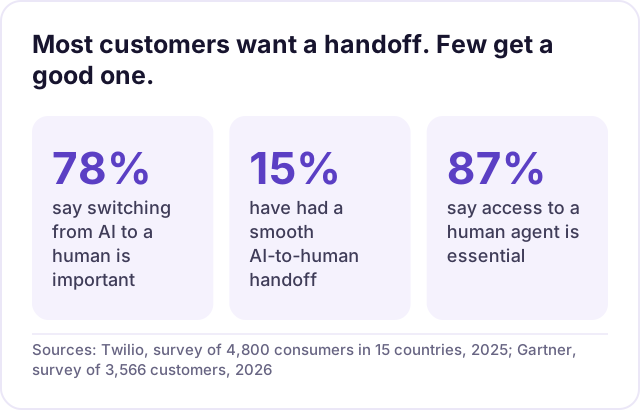
The gap is wide worldwide too. 78% of consumers say switching from an AI agent to a human is important, but only 15% have had a smooth one (Twilio, 2025). 87% of customers say access to a human agent is essential when companies use AI in service. Only 27% would try a chatbot again after a bad experience (Gartner, 2026).
When should an AI voice agent hand a call to a person?
When the caller asks, when the AI is stuck, or when the call needs a person’s judgement. Write these rules into the agent’s script before launch, so it never has to guess.
| When this happens | Example | Rule to write in the script |
|---|---|---|
| The caller asks for a person | “Can I talk to someone?” | Transfer at once, no arguing |
| The agent misunderstands twice | Wrong order number heard twice | Apologise and transfer |
| The caller says they’re unhappy | “This is the third time I’m calling” | Transfer straight away |
| A complaint or dispute | “I never took this loan” | Transfer; don’t argue or promise |
| A change to money, cover or terms | Adding parents to a health policy | Transfer to the team that handles it |
| A language you haven’t set up | Caller switches language mid-call | Transfer to someone who speaks it |
The first rule matters most. If a caller asks for a person, don’t make them ask three times. Gartner says chatbots should connect customers to human support, “not containment traps”: bots that keep people in at any cost (Gartner, 2026).
Lending and insurance need the strictest rules. Disputes, hardship and complaints should always reach a person. Our guide to AI calls for loan collections lists the calls that should never stay with the AI.
Cold, warm or announced: which transfer should you use?
Use a warm or announced transfer for customers. A cold transfer is fine only between internal desks.
- Cold (blind) transfer: the call goes straight to another number, with no introduction (GoTo).
- Warm transfer: the caller is introduced and the reason given before they are connected. In some systems the two sides talk first while the customer waits (Twilio Docs).
- Announced transfer: the person who answers hears a short message before the caller is connected. The person can even be given a chance to decline (Twilio Docs).
How you ring the team matters as much. Ringing one person at a time is slow if the first person is busy. Ringing everyone at once means whoever is free picks up first. Microsoft calls this attendant routing (Microsoft Learn).
| Transfer type | What the caller hears | Risk | Use it for |
|---|---|---|---|
| Cold | A new voice, with no introduction | Caller repeats everything; may reach voicemail | Internal desk-to-desk transfers |
| Warm | A short wait while the two sides talk | Slower, and needs a free person | Complaints, high-value calls |
| Announced | “I’m connecting you…”, then the person | Needs someone free to answer | Most customer calls |
MagickVoice’s AI transfer works like an announced transfer. The AI tells the caller it is connecting them, and you can have the transfer announced to the person first, so a voicemail never takes the caller.
What does a good AI to human handoff sound like?
It sounds like a receptionist who knows where to send you. The AI says what it is doing, the right team picks up, and the caller never hears a dead line.
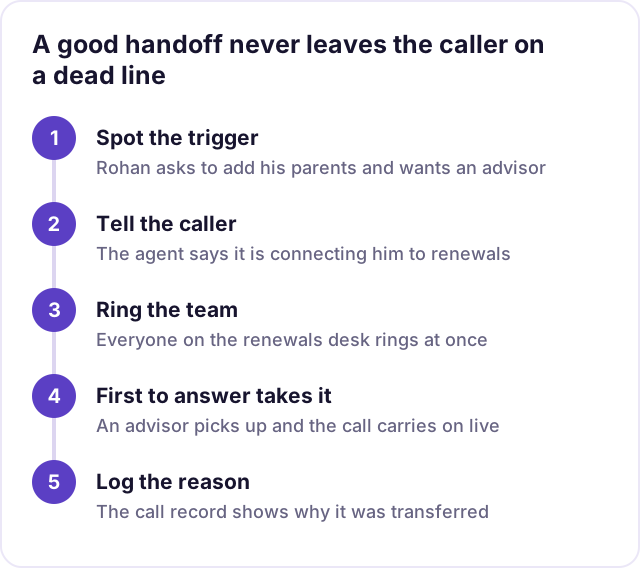
Take Rohan. He is renewing his health policy with an AI agent and wants to add his parents to the cover. That changes the cover and the premium, so he asks for an advisor. The agent doesn’t end the call. It tells him it is connecting him, then rings the whole renewals desk at once. The first advisor to pick up gets the call, live, in the middle of the conversation.
The agent should be honest from the start, too. Say in the greeting that the caller is speaking to an AI agent. Most Indian consumers want this. 71% say brands should declare an AI conversation at the start (Twilio, 2026). Your business remains responsible for that disclosure, for consent and for permitted calling hours.
What should callers hear if nobody is free?
An honest message, a real time for a callback, and then the callback. Silence or an endless ring is the worst outcome, because the caller asked for a person and got nothing.
Write the message before you need it. For example: “Our renewals team is busy right now. An advisor will call you back on this number within two hours.” Then make sure someone owns those callbacks. A WhatsApp or SMS after the call with the same promise helps too.
Two Indian yardsticks help you set a target:
- TRAI’s benchmark for telecom operators is that at least 95% of calls asking for a person (“voice to voice”) are answered within 90 seconds (TRAI wireline quality report, 2026). It applies to telecom only, but it is a fair bar for any support line.
- An RBI-appointed committee recommended that call-centre menus at RBI-regulated entities, such as banks and NBFCs, always include an option to speak to a customer care executive, and an automatic call-back when a call drops (RBI, 2023). It is a recommendation, not a confirmed rule, but it shows the standard an RBI committee thinks customers should get.
If transfers often go unanswered, the fix is often staffing at peak hours, not the AI. Check when transfers happen and match your shifts to them.
How do you stop customers repeating themselves?
Send each transfer to a team with one clear job, and teach the person who answers to confirm rather than restart. Half of Indian callers say they had to repeat themselves after an AI handed them over (Twilio, 2026).
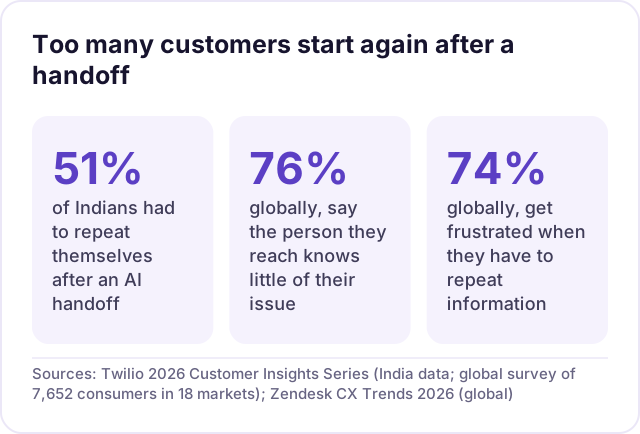
The global picture is the same (Twilio, 2026; Zendesk CX Trends 2026). Three habits help:
- Name the destination for its job. A destination is the team the AI rings. “Renewals desk” beats “Support”, because the advisor who answers already knows the call is about a renewal.
- Open with a check, not a form. “You’re renewing and want to add your parents, right?” takes five seconds. Asking for the policy number again takes much longer and annoys the caller.
- Read the transfer reasons every week. If the same reason keeps coming up, either teach the AI to handle it or change who the destination rings.
Which numbers should you track?
Five numbers tell you if the handoff works. We found no reliable Indian benchmarks for these, so set your own baseline in the first month and improve from there.
| Metric | What it tells you |
|---|---|
| Transfer rate | Share of AI calls that needed a person |
| Top transfer reasons | What to teach the AI next, or where you’re short |
| Transfers answered by a person | Whether your team is free when callers need it |
| Time to answer a transfer | How long callers wait after the AI hands over |
| Repeat calls within 7 days | Whether the person who answered solved the problem |
A falling transfer rate is good only if satisfaction holds. If it drops because callers give up, you have built the containment trap Gartner warns about. MagickVoice shows sentiment, intent and KPI analytics on every call, and the Calls page shows why each call was transferred.
How do you set it up in MagickVoice?
AI transfer takes three steps, and you can test it in one call.
- Turn on “Transfer to a person” in your call script, and describe in the script when the agent should hand over.
- Create a destination. Give it a name, add the people to ring, and choose what callers hear if nobody is free. You can also have the transfer announced to the person first, so a voicemail never takes the caller.
- Place one real test call to check that it reaches someone.
On the Calls page you can see why the AI transferred each call and that a person took it. The demo at the top of this post walks through this setup too.
Then roll it out in stages:
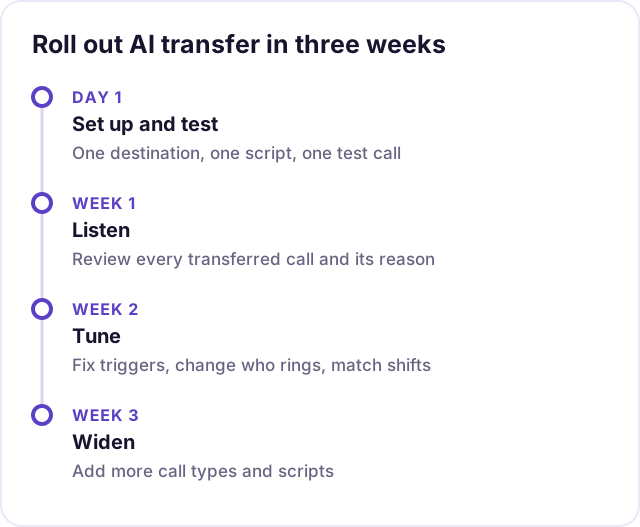
Your AI handles the routine. Your people handle the rest. For support teams, MagickVoice customers see up to 83% of calls resolved automatically (customer support use case). The handoff is what makes the other calls go well. If you are moving from an old phone menu, start with our AI voice agent vs IVR guide, or read the product FAQ.
Want to hear an AI voice agent for yourself? Call Aria, our own agent, on +91-80653-90179 — any time, in 7 languages.