Guides
Best AI voice agent for debt collection in India: a 2026 buyer's guide
How to pick an AI voice agent for debt collection in India: a 10-point scorecard built on RBI's 2027 recovery rules and TRAI's AI-call norms, plus a pilot plan.

The best AI voice agent for debt collection in India is the one that passes your compliance checks and beats your current process in a test on your own accounts. No single vendor is best for every lender. A large bank, a mid-size NBFC and a collection agency need different things, and every one of them is accountable for the calls made in its name.
This guide gives you a way to choose. It covers the RBI and TRAI rules every AI collection call must follow and a 10-point vendor scorecard you can paste into an RFP. Then it shows how to compare prices and run a 30-day pilot. It is written for collections heads at banks, NBFCs, HFCs and fintech lenders, and for third-party collection agencies.
Last checked against RBI and TRAI documents: 29 October 2026. This is a buyer’s guide, not legal advice. Get your compliance team to sign off before you go live.
Where does an AI voice agent fit in collections?
An AI voice agent fits the high-volume, simple calls at the start of the cycle. Think pre-due EMI reminders, bounce and NACH-failure alerts, early-bucket follow-ups and calls about a promise to pay (PTP) that has slipped. Disputes, hardship, settlements and older dues need a trained person.
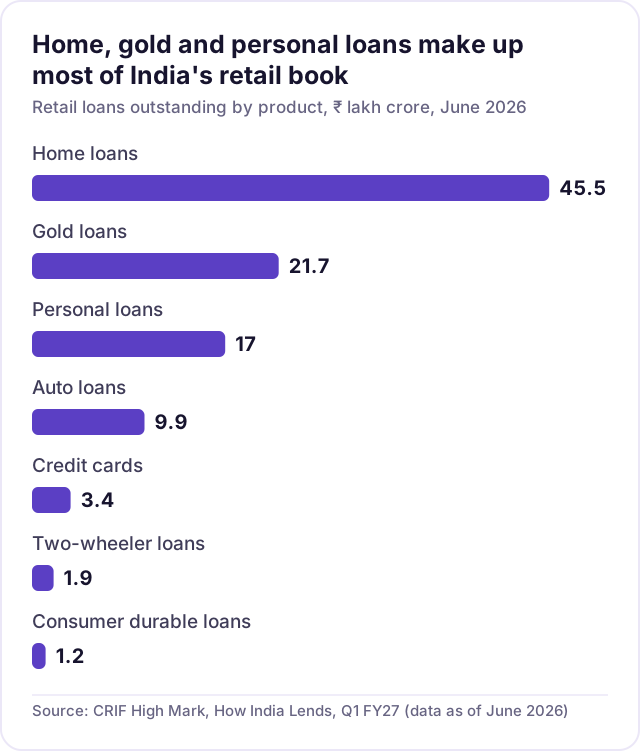
India’s retail loan book stood at ₹178.6 lakh crore in June 2026, up 19.2% in a year (CRIF High Mark, How India Lends, 2026). More loans mean more reminders and more early-bucket calls than most teams can make well by hand.
The split between AI and people matters more than the vendor you pick. Get it wrong and even a good agent will annoy borrowers.
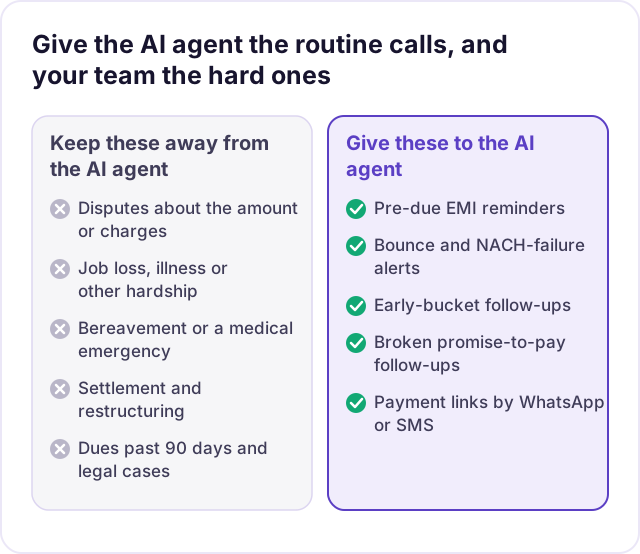
Our practical guide to AI loan collections in India covers this split, a sample call and a Hindi example in more detail. The rest of this guide is about choosing the vendor.
Which RBI and TRAI rules apply to AI collection calls?
RBI’s recovery rules bind the lender, its employees and its recovery agents. They don’t mention AI at all, so the safe approach is to hold the AI agent to every rule a human caller follows. TRAI’s rules then decide which numbers you call from and how automated calls must be declared.
Two clauses tie these together. RBI’s 2022 circular says the “ultimate responsibility” for outsourced activities stays with the lender (RBI, 2022). And the new NBFC directions tell lenders to follow TRAI’s commercial-communication rules (TCCCPR) as well (para 100AB, RBI, 2026).
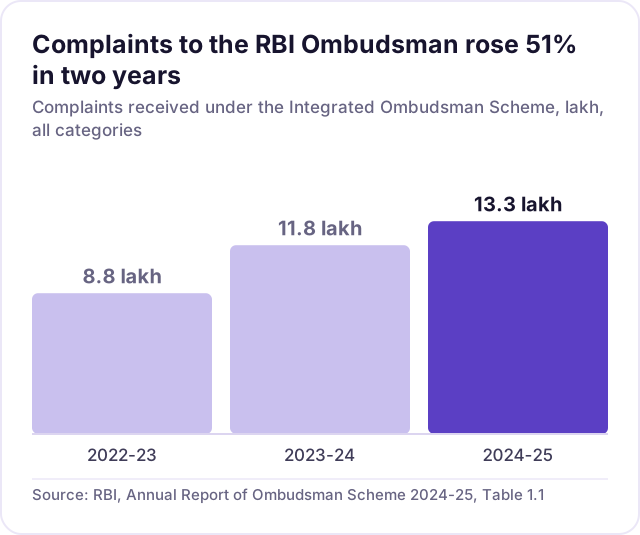
Borrowers are also complaining more. Complaints to the RBI Ombudsman rose from 8.8 lakh in 2022-23 to 13.3 lakh in 2024-25 (RBI Ombudsman annual report, 2024-25). These cover every kind of complaint, not only recovery, but a careless call script adds to the pile.
RBI: what changes on 1 January 2027
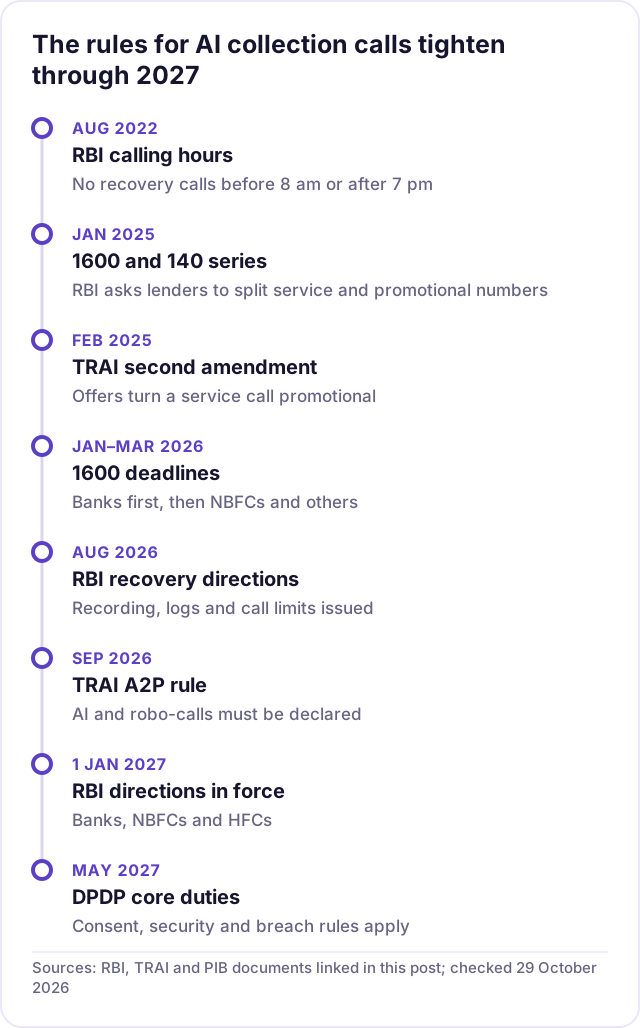
Since 2022, RBI has barred recovery calls before 8 am or after 7 pm, and persistent calling (RBI, 2022). On 6 August 2026, RBI issued new recovery directions for banks, NBFCs, HFCs and other lenders. They apply from 1 January 2027. The NBFC rules are below. Banks get the same rules in parallel paragraphs (RBI, 2026), and HFCs must follow the NBFC paragraphs (RBI, 2026).
| Rule (NBFC directions, RBI/2026-27/230) | What it means for your AI agent |
|---|---|
| Contact only between 08:00 and 19:00, unless the borrower expressly asks otherwise (para 100Y(4)) | Enforce the window in IST, per product, in the platform |
| Honour a borrower’s request to avoid a particular time (para 100Y(4)) | Capture “call me after 6” and stop calling at that time |
| Discuss dues only with the borrower or guarantor (para 100Y(1)) | Check identity before mentioning any amount |
| Avoid occasions such as a bereavement or medical emergency (para 100Y(6)) | Detect these on the call and hand off to a person |
| No excessive calling or messaging, threats or anonymous calls (para 100Z) | Cap attempts per borrower across campaigns, and always say who calls |
| Record recovery calls, log the time and number of calls, keep records for six months (para 100P) | Record every call, announce it, and keep recordings for six months |
| Put the grievance officer’s contact details in all recovery communication (para 100AA) | Send them by SMS or WhatsApp after the call |
| Use only IIBF-certified recovery agents, and publish your list of recovery agencies (paras 100I, 100K) | Applies to your human agents and agencies, not to the software |
One detail matters for AI. The new section covers borrowers in default. It applies to normal-course collection only “wherever explicitly specified” (para 100A), so pre-due reminders may fall outside it. Applying the same limits to every call is simpler and safer.
TRAI: 1600 numbers, A2P calls and no offers
TRAI’s rules decide where your calls come from and how automated calls are declared. Three are relevant to an AI collections agent.
| Rule | What it means for your AI agent |
|---|---|
| RBI-regulated entities make service and transactional calls only from 1600-series numbers (RBI, 2025). TRAI set deadlines from 1 January to 1 March 2026 (TRAI, 2025) | The platform must be able to call from your 1600 numbers |
| Calls by software, robo-calls or an artificial voice are A2P calls. Senders must declare them and their caller IDs to the operator in advance, or they count as spam (TRAI, 2026) | Declare your AI calls and caller IDs before you go live |
| Promotional content mixed into a commercial call makes it a promotional call (TRAI, 2025) | Keep top-up and cross-sell offers out of reminder calls |
The A2P rule comes from TRAI’s Third Amendment to the TCCCPR, issued on 18 September 2026. The declaration applies 60 days after the regulation is published in the Gazette. Confirm the exact start date with your telecom operator.
DPDP: what changes in 2027
Collection calls use borrowers’ personal data, so the Digital Personal Data Protection (DPDP) Rules, 2025 apply. The lender decides how the data is used, and the voice AI vendor processes it on the lender’s behalf. The core duties apply 18 months after the rules were notified, so from May 2027 (PIB, 2025). The highest penalty, up to ₹250 crore, is for failing to keep reasonable security safeguards. Ask every vendor for a data processing agreement before the pilot.
What’s still unclear
Some points have no official answer yet. Say so in your vendor discussions, and don’t let a vendor tell you otherwise without a source.
- Do recovery calls need 1600 numbers? RBI and TRAI require 1600 for service and transactional calls, but neither says whether a recovery call is one. Industry body FIDC has asked RBI to clarify.
- Microfinance hours. RBI’s microfinance directions use a tighter 9 am to 6 pm window (RBI). Check which window applies to your microfinance book from 2027.
- AI disclosure. RBI’s FREE-AI committee recommends telling customers when they are dealing with AI, with an option to switch to a person (RBI, 2025). It is a recommendation, not a direction, but it is the safe default.
- Agency numbers. No document says whether a third-party agency can hold its own 1600 numbers. The 1600 series is allotted to government and BFSI entities.
What should you check on every vendor?
Run every vendor, including us, through the same 10 checks. A demo shows you the best call. These checks show you what happens on the worst one. Paste the table into your RFP and ask for a live demonstration of each “pass”, not a slide.
| # | Check | Ask the vendor | A pass looks like |
|---|---|---|---|
| 1 | Calling window | Can I set 08:00–19:00 IST per product, so no call goes out outside it? | The platform blocks the call, and logs any exception the borrower asked for |
| 2 | Attempt caps | Can I cap calls per borrower per day and week, across all campaigns? | One cap across every campaign, with the time and count of each call logged |
| 3 | Recording | Is every call recorded and announced? Who sets retention? | All calls recorded, an opening line about it, and six months’ retention you control |
| 4 | Identity check | What happens before the agent names an amount? | It confirms the borrower or guarantor first, and says nothing to anyone else |
| 5 | AI disclosure | Does the agent say it is an AI? Can the borrower ask for a person? | Disclosed in the first line, and “talk to a person” always works |
| 6 | Numbers and telecom | Can you call from my 1600 numbers? Will you help with the A2P declaration and DND checks? | Yes to all three, with written steps for the operator declaration |
| 7 | Languages | How does it handle my borrowers’ languages, Hinglish and amounts? | It passes your own recordings test (see the next section) |
| 8 | Hand-off | How do disputes and hardship reach my team? | Live transfer or a callback, with the transcript attached |
| 9 | Data | Where is data hosted? Do you train on my recordings? Will you sign a DPDP processor agreement? | Hosted in India, encrypted, no training on your calls, agreement signed |
| 10 | Integration | Do PTPs and dispositions write back to my LMS or CRM? Can you send payment links? | Structured outcomes in your system the same day, links by WhatsApp or SMS |
Watch out for these red flags in a vendor pitch:
- “We are RBI-compliant.” RBI regulates lenders, not software. Compliance is your duty, and a vendor can only give you the controls to meet it.
- Guaranteed recovery numbers. Results depend on your book, buckets and borrowers. A good vendor asks for a pilot.
- No recordings, or recordings you can’t export. You need them for six months, and for any complaint.
- Offers inside reminder calls. A top-up pitch turns a service call into a promotional one under TRAI rules.
- No answer on hand-offs. If the agent can’t pass a hardship call to a person, it will mishandle one sooner or later.
How do you test Hindi and regional-language calls?
Test on your own borrowers’ speech, not on a demo script. The best voice AI for Hindi loan recovery calls is the one that gets your borrowers’ amounts, dates and promises right most often. That isn’t always the one with the longest language list.
Most borrowers don’t speak textbook Hindi on a collections call. They mix in English, give dates as “next Monday” or “salary ke baad”, and call from a bus or a shop. A useful language test covers that:
- Pick 30–50 real recordings from your current calls, across your top languages and regions. Remove names and account numbers first.
- Play the borrower side to each vendor’s agent, or have your team role-play the same scripts.
- Score three things: whether the agent heard the amount and the promise date correctly, whether it answered in the borrower’s language, and whether it switched when the borrower switched.
- Listen for tone. A correct but rude-sounding call fails. RBI’s directions ask for civil interaction (para 100Y(2)).
Repeat the test in every language you plan to use. A vendor can be strong in Hindi and weak in Telugu or Marathi. Also check the borrower can hear the agent clearly on a weak mobile line.
How do you compare pricing across vendors?
Compare cost per resolved account, not price per minute. Vendors price in units that don’t line up, so the cheapest rate on paper is often not the cheapest result.
| Pricing model | How it works | What to ask |
|---|---|---|
| Per minute | Talk time, often rounded up to whole 60-second pulses | Is it per second or per pulse? Is telephony extra? GST? |
| Per connected minute | Billed only once the call connects, sometimes by the second | Are silence and hold time billed? Are failed calls free? |
| Credits | Prepaid credits used per minute of voice and per message | How many credits per minute, per WhatsApp and per SMS? |
| Performance-based | A share of what is collected | How is “collected” counted, and over what period? |
To compare them, run each vendor on similar accounts and use one formula:
Cost per resolved account = (voice charges + message charges + telephony) ÷ accounts that paid or kept their promise to pay
Here is how two quotes can flip. These are illustrative numbers, not real vendor prices.
| Illustrative example (10,000 accounts) | Vendor A | Vendor B |
|---|---|---|
| Rate per minute | ₹3 | ₹5 |
| Minutes used | 30,000 | 24,000 |
| Voice + messages + telephony | ₹1,20,000 | ₹1,28,000 |
| Accounts resolved | 1,500 | 2,000 |
| Cost per resolved account | ₹80 | ₹64 |
Vendor B costs more per minute and more in total, but each resolved account costs less. Ask every vendor for a full quote for your pilot volume, with telephony, messages and taxes included, so the sums are fair.
How do you run a fair 30-day pilot?
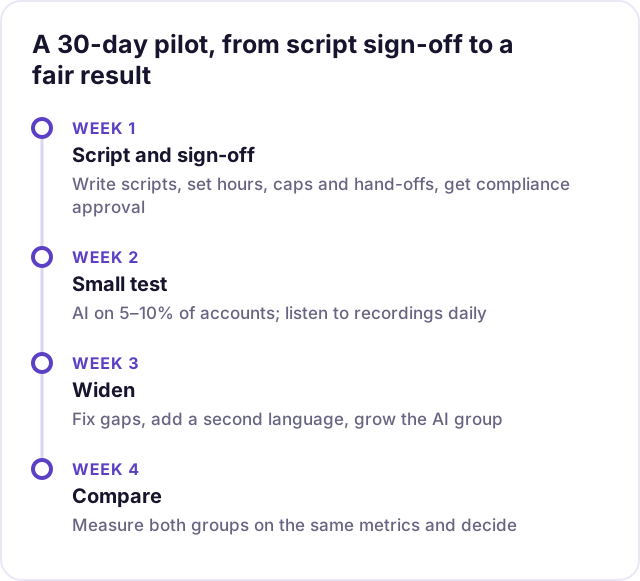
Run a holdout test. Split similar accounts into two groups, give one group to the AI agent and keep your current process on the other, then compare outcomes. A demo or a vendor’s case study can’t tell you what will happen on your book. A holdout can.
Keep the two groups alike in product, bucket and region, so the only difference is who makes the calls. Pick one product and one or two early buckets to start, and run for at least one billing cycle, ideally two.
Measure both groups on the same numbers, from the first day.
| Metric | What it tells you |
|---|---|
| Right-party contact rate | How often you reach the borrower, not someone else |
| Promise-to-pay (PTP) rate | How many contacted borrowers commit to a date |
| Kept-PTP rate | How many of those promises turn into payments |
| Roll-forward rate | How many accounts slip into the next bucket |
| Hand-off rate | How often the agent passes the call to your team |
| Complaints per 1,000 calls | Whether borrowers find the calls fair |
| Cost per resolved account | What each result really costs, from the pricing formula |
Each stage narrows the one before it, so a weak link early on caps everything after it.
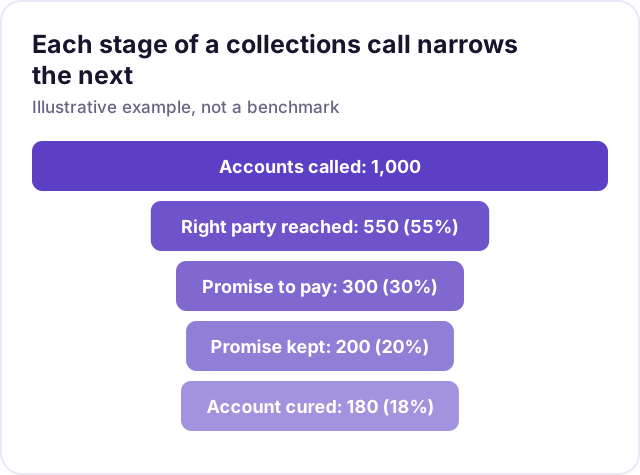
Don’t judge on promises alone. An agent that collects many promises that aren’t kept looks good in week two and bad in week four. The kept-PTP rate and roll-forward rate are the ones that move your book.

Watch complaints and hand-offs closely in week two. A rise in either usually means the script is unclear or the calls are too frequent. Both are easy to fix early.
What should a collection agency check?
An agency should check everything above, plus whether the platform can keep each lender client separate. Most vendor pages are written for lenders. Agencies get the same rules passed down through their lender contracts, and they work for several lenders at once.
RBI’s directions require lenders to use only IIBF-certified recovery agents (para 100I) and to publish the list of agencies they use (para 100K). They also need an undertaking that agency staff follow the lender’s code of conduct (para 100J), and recordings of recovery calls (para 100P). The IIBF certificate for debt recovery agents explicitly covers recovery telecallers (IIBF), so your human team still needs it. Agents already working have one year from 1 January 2027 to get certified.
| Agency check | Why it matters |
|---|---|
| Separate workspace per lender | Each lender’s data, scripts and recordings stay apart |
| Per-client rules | Calling hours, attempt caps and scripts set by each lender |
| Per-client recording exports | You can hand any lender its own recordings for an audit or complaint |
| Per-client billing | You can bill each lender for its own minutes and messages |
| Caller ID per client | Calls show the right number, including a lender’s 1600 number where needed |
| Per-client reports | PTPs, kept promises and complaints reported to each lender separately |
Ask your lender clients early which numbers they want you to call from. The 1600 series is allotted to government and BFSI entities, and no document yet says whether an agency can hold 1600 numbers itself. Until that’s clear, plan to call on the lender’s numbers through your telecom operator.
Where does MagickVoice fit?
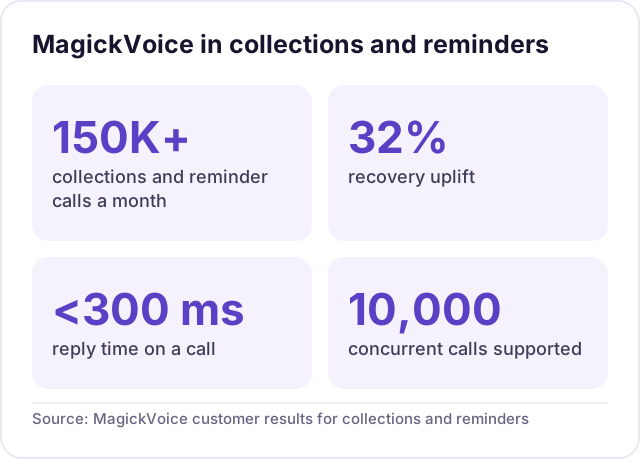
MagickVoice is a no-code platform for building AI voice agents, with WhatsApp, SMS and email follow-ups from the same place. Collections teams use it for EMI reminders and early-bucket calls. Customers using it for collections and reminders see a 32% recovery uplift across 150K+ calls a month. Your own pilot tells you what to expect on your book.
Against the scorecard, here is what MagickVoice offers today:
- Languages: 25+ languages, including 10+ Indian languages with native accents, such as Hindi, Tamil, Telugu, Kannada, Malayalam and Marathi.
- Data: hosted in India (Mumbai region), with TLS 1.2+ in transit and AES-256 at rest for sensitive data. Call recordings and prompts are never used to train foundation models.
- Telecom: DND checks before every call, DLT and KYC support, and Twilio, Plivo and Exotel with automatic failover.
- Channels: inbound and outbound voice, WhatsApp, SMS and email under a single API, so a payment link can follow the call.
- Analytics: sentiment, intent and KPI analytics on every call, a real-time dashboard, team roles and audit logs.
- Setup and pricing: build an agent in about 5 minutes without code. Free to start, then pay-as-you-go credits per minute and per message.
For the other checks, ask us the same questions you ask everyone else, and see the answers live in your pilot. You remain responsible for consent, permitted calling hours and telling borrowers they are speaking to an AI agent. See security and compliance for details.
How do you get started?
Start with the checks, then let a pilot decide.
- Map the RBI and TRAI rules for each product with your compliance team, using the tables above.
- Send the 10-point scorecard to three or four vendors and ask for a live demonstration of each check.
- Run the recordings test in your top two or three languages.
- Run a 30-day holdout pilot on one product and one or two early buckets.
- Decide on kept promises, roll-forward and cost per resolved account, not on the demo.
Want to hear an AI collections call first? Call Aria, MagickVoice’s own AI voice agent, on +91-80653-90179 and try it in Hindi or Tamil. Then see how AI voice agents for loan collections work on MagickVoice, read how an AI voice agent differs from an IVR, or check the product FAQ.
Want to hear an AI voice agent for yourself? Call Aria, our own agent, on +91-80653-90179 — any time, in 7 languages.